Supertramp Hops Aboard The 50th Anniversary Release Bandwagon
2025 surely seems to be shaping up a a pretty significant year for anniversary album reissues and I suppose that may be telling us that a hell of a lot of great music was born in 1975. I remember those days fondly now and am somewhat ashamed to admit that I probably took them for granted. Great new music was coming out constantly back then and as I set here thinking about that now, I wonder what happened. Why did it stop?
I suppose that’s a question for another day and is a bit far outside the scope of this article.
I’ve been a Supertramp fan since sometime in the 1970s and was no doubt lured in after hearing one of their hit songs on FM radio. Before long I was lining up at the store buying their records and I have not stopped listening to Supertramp since.
Supertramp was formed in 1970 by Rick Davies and Roger Hodgson, with other coming and going before the “classic lineup” solidified: Davies (keyboards, vocals), Hodgson (guitar, vocals, keyboards), John Helliwell (saxophones, woodwinds), Dougie Thomson (bass), and Bob Siebenberg (drums). That lineup came into full clarity with Crime of the Century in 1974, which was their breakthrough in many ways.
Their sound in those early years was a fascinating blend: progressive rock complexity, thoughtful lyrics, lush arrangements, plus memorable pop-hooks. Hodgson and Davies had somewhat different songwriting styles—Hodgson tended toward more expansive, dreamy, melodic songs, Davies toward grit, blues, more grounded rock. Together they complemented each other in a way that made Supertramp more than the sum of its parts.
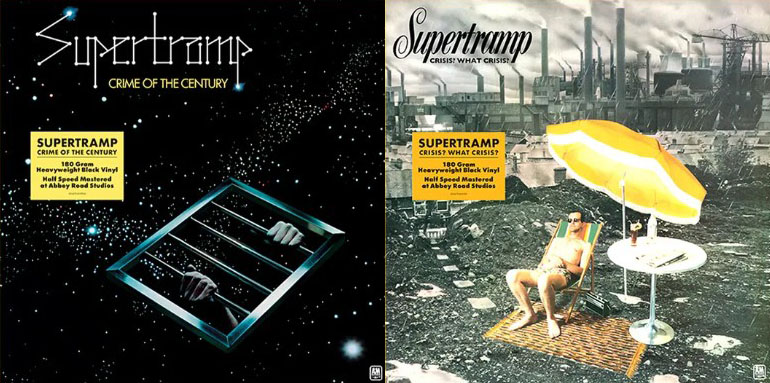
After Crime of the Century, they followed up with Crisis? What Crisis? later in 1975, then moved on to Even in the Quietest Moments…, Breakfast in America, and so on. Their peak commercial success came with Breakfast in America, but many fans always found Crime of the Century and Crisis? What Crisis? to be uniquely special with a sound that was more raw, more adventurous, and more emotionally resonant.Released in September 1974, Crime of the Century is often seen as the album where everything came together for Supertramp. It was the third studio album, but the first with that classic lineup. Also their first big commercial breakthrough: it hit UK charts very high (No. 4), was the first time they cracked the US Top 40, and built a reputation they would ride for years.
Notable tracks included:
“Dreamer” — Hodgson’s song (one of his earliest successes). Upbeat, whimsical, playful, yet with emotional undercurrents. For many listeners, this was their entry into Supertramp.
“Bloody Well Right” — One of Davies’ big contributions. More rock-edged, with biting lyrics, strong piano and organ, great guitar work. Probably my favorite Supertramp song of all time.
“School” — A compelling opening track: moody, reflective, with lyrics about growing up and disillusionment.
“Hide in Your Shell” — Deeper and more introspective. A song that builds in emotional intensity.
“Crime of the Century”, ends the vinyl side with a dramatic statement—both musically and thematically. It wasn’t a single, but it’s become emblematic of the album as a whole.
Other songs like “Rudy,” “If Everyone Was Listening,” “Asylum” offer variety: some more orchestral, some more intimate, some more rock, all tied together by richly textured instrumentation (John Helliwell’s sax, keyboard flourishes, lyrical duality between Hodgson and Davies).Crime of the Century was recorded between February and June of 1974 in several London studios (Ramport, Trident, Scorpio). Part producer was Ken Scott, along with the band. The arrangements became more ambitious: string arrangements, intricate keyboard work, more layered production. Fans often talk about how this album feels cohesive and is not just a collection of songs but a real sonic journey.
It’s the album where Supertramp seemed to finally find its identity: thoughtful, a bit theatrical at times, but not over-polished. It could rock and it could dream, and it pulled that off without sounding pretentious.
Released in November 1975, barely over a year after Crime, Crisis? What Crisis? has often been seen as the quieter, more uneasy sibling of Crime. It came after touring, and under somewhat more pressure (from record labels, from expectations). While it doesn’t always get the same universal praise, it holds a special place for fans because it grew out of the momentum and tension that survival in the music business brings.
Stand-out tracks from the album include:
“Lady” — Perhaps the most accessible song on the album; it’s heartfelt and melodic.
“Sister Moonshine” — More rock-oriented, heavier guitar, strong rhythm.
“Ain’t Nobody But Me” — Showcases Davies’ tougher vocal side.
“Just a Normal Day” and “Poor Boy” — Contemplative, slower paced, emotionally resonant
The themes tend toward disillusionment, consequences of fame, weariness, reflection. It’s not as polished or tightly focused as Crime, but it has depth, warmth, and some outstanding moments.

Some of the Crisis? What Crisis? material was developed while still riding the wave from Crime of the Century but there was less time, more exhaustion and more demands. Parts were recorded in London, but also in the U.S., which introduced new dynamics. The title and the cover art reflect that tension: the band felt they were in “crisis” yet trying to carry on almost as if everything were fine as good Brits would be expected to do.
At 50 years, both albums are being revisited (remastered, reissued, possibly expanded). For longtime fans, these anniversary editions are more than nostalgia. They’re an opportunity to hear the music anew through improved audio, previously unheard takes or live versions, and packaging that cares about detail.
While full details for all the bonus content for this 50th anniversary is still forthcoming, the history of prior remasters suggests they might include:
Remastered audio (vinyl and CD) with attention to preserving dynamic range.
Live concert recordings from the era (e.g. from tours supporting these two albums).
Booklets with photos, essays from band members (Davies, Hodgson, Helliwell), reflections on songwriting and what those songs meant at the time.
Possibly some unreleased demos or alternate takes.
For example, Crime of the Century has had previous reissues with concerts, restored artwork, and audio restorations. Here’s hoping the 50th will bring something equally rich.
As much as this year is a celebration, that’s surely tempered by profound sadness. On September 6, 2025, Rick Davies died at age 81 after a long battle with multiple myeloma. Davies was more than just a performer—he was the heart of Supertramp. His keyboards, vocals and his songwriting (especially after Hodgson’s departure) kept the band’s flame lit.
Knowing that Davies is gone adds weight to this anniversary. It deepens the gratitude for treasures like “Bloody Well Right,” “Dreamer,” and “Lady” that influenced so many lives. As fans, we realize these songs now carry echoes. Not just of what was, but of what will no longer be. And yet, they endure.
Why do these albums still matter? For me—and I suspect for many others—these two albums capture a moment when Supertramp was balancing on the edge of greatness. They weren’t yet the radio-superstars of Breakfast in America, but they were defining a voice: introspective, ambitious, melodic, willing to explore light and shadow.For new listeners, these anniversary editions will likely offer clearer audio, maybe songs we’ve only known from bootlegs or room-recorded concerts. For old fans, they are a reminder that great art lives beyond its moment.
Celebrating fifty years is about honoring what was, and also allowing the music to keep living. Rick Davies’ passing means new albums won’t come, the voices won’t line up the same, but remasters, archival releases, box sets let the music stay alive in living rooms, cars, headphones.
These albums will continue to inspire, to comfort, stir memories and to create new ones for younger listeners discovering them for the first time.
So here’s to Supertramp: for the songs that made you think, the arrangements that moved your heart, and Rick Davies—whose art will live on in every piano chord, every “Bloody Well Right,” every moment when Supertramp felt like more than a band, but a feeling.
Godspeed, Rick. We’ll keep listening.