AI-Generated Classic Rock: Fooling Fans For Fun or Crossing the Line?

It appears we have a reached a point where we can no longer trust our eyes or ears when we are online. That’s not what I would call “new news” and I think most sensible people have been skeptical regarding online content for a long time. That was a wise approach but what we are witnessing currently is (or should be) taking online skepticism to an entirely new and unprecedented level. Artificial Intelligence or AI as it is most-often called, has developed to the point where it can now create stunningly realistic images, videos, voice impersonations and even music.
At this point, what AI is capable of with regard to online content is limited only by the user’s imagination and frankly, that’s probably a pretty serious understatement. These days it appears that AI systems may be developing their own “imagination” and are able to create unique and frighteningly realistic content with very little prompting from a human user.
It is undeniable that AI can be useful. I use it almost daily myself, mostly for assistance with technical problems such as when my computer or home network acts up. While it is extraordinarily helpful much of the time and offers hope for wonderful advancements in science and medicine, many AI experts are expressing fear that AI will become too clever and far surpass the intelligence of any human being currently living or that has ever lived.
The danger that would present to our existence is being debated but it does not seem unreasonable to presume that super-intelligent AI could some day question whether the human race deserves to continue to exist.
For now, however, our concerns with regard to AI are decidedly less apocalyptic and let’s all hope it stays that way.
As far as the ever-evolving world of rock music is concerned, a new wave of content is stirring up conversations online: AI-generated images and memes featuring classic rock legends in wildly implausible scenarios are popping up all over. From Bob Dylan sobbing in a heartfelt embrace to Phil Collins supposedly rescuing a child at an airport, these fabricated visuals are flooding social media platforms, leaving some fans amused, others confused, and a growing number outright frustrated.
As artificial intelligence tools become more accessible, they’re reshaping how we engage with rock history, but not without sparking debates about authenticity, misinformation, and the ethics of digital creativity.
The trend gained traction earlier this year, with images appearing on sites like Facebook and X, often shared by pages dedicated to rock nostalgia. One prominent example depicts Steven Tyler of Aerosmith hammering away at a doghouse for rescued animals, complete with a caption praising his “heart of gold.” Another shows Mick Jagger, Elton John, and Rod Stewart harmonizing at Ozzy Osbourne’s memorial service—a poignant but entirely fictional scene, especially poignant given Osbourne’s recent passing.
These aren’t grainy fan edits; they’re polished creations from AI generators like Midjourney or Stable Diffusion, capable of blending real photos with imagined elements to produce eerily convincing results.
Rolling Stone highlighted this phenomenon in a recent feature, noting how these memes often portray aging rock icons in vulnerable or heroic moments that play on fans’ emotions. For instance, an image of Eric Clapton serenading Robert Plant in a hospital corridor elicited sympathetic comments like “Prayers for Robert,” while a fake shot of Bruce Springsteen buying a diner to feed the homeless drew admiration for his “generosity.”
Even more bizarre entries include Adele and Adam Lambert singing at Malcolm-Jamal Warner’s memorial or Taylor Swift joining Tyler to serenade Queen Camilla with “Happy Birthday.” The accompanying text amps up the drama, turning simple visuals into “heartwarming” narratives that feel lifted from a tabloid dream.
Fan reactions have been mixed, as seen in online forums and comment sections. On Reddit’s r/Music, users debated in a post about these “unreal” images, with some dismissing them as “lazy AI bullshit” and others admitting they were briefly fooled.

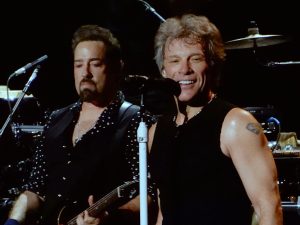
Recognize the rockers in the image above? Unlikely, since it is AI-generated. You probably suspected as much since this is an article about AI-generated content. But suppose you just happened across it on some rock-related site. Would you think it was a product of AI? Probably not, and that goes for me, too. How often do we take the time to really scrutinize an image we see online. Apparently not often enough but doing so seems exhausting. And as AI’s capabilities continue to improve, closely scrutinizing an online image may not help us determine whether an image is real or AI.
The confusion stems from the incredible realism of these tools. Diffusion models, which power many generators, excel at creating lifelike details, drawing from vast datasets of existing photos. But as Lev Manovich, a cultural theorist at City University of New York, points out, they often recycle familiar tropes: fantasy, comic book styles, or anime influences, which can make rock legends look like characters from a ’70s prog-rock album cover. This aesthetic familiarity tricks the eye, especially when paired with captions that mimic real news headlines.
Artists themselves have largely stayed silent, perhaps strategically. Spokespeople for Dylan, Collins, and others declined comment in recent reports, leaving fans to speculate. Dick Van Dyke, featured in one absurd meme alongside Dylan and Collins, told Rolling Stone he finds the images “impressive and terrifying” but jokingly invited the rockers to his actual 100th birthday party.
In a genre built on raw authenticity—like the rebellious spirit of The Who or the bluesy grit of Led Zeppelin—fake narratives could erode trust.
The debate extends beyond memes to AI’s broader infiltration of rock music. Bands like Within Temptation faced backlash for using AI in music videos, with fans accusing them of “stealing” from real artists’ styles.
Similarly, an “indie rock band” called The Velvet Sundown was exposed as AI-generated, with its music flagged by detection tools like those from Benn Jordan, who identified Suno AI as the source. The group denied it, but the controversy fueled calls for transparency in AI music.
Political figures aren’t immune and in a free society, one would surely not expect them to be. A bizarre AI video of Donald Trump performing a classic rock anthem went viral, drawing mockery for its “cringe” factor and raising questions about deepfakes in public discourse. Some AI-generated content is obvious at first glance but that surely does not apply to all of it. An increasing quantity of it is turning up regularly that is astoundingly realistic.
In creative experiments, AI has “written” rock songs mimicking Nirvana or Metallica, ranked by some outlets for their eerie accuracy—or lack thereof.
Projects like The Rockbots use tools like Stable Diffusion to generate band images and music, blending AI with rock aesthetics but sparking ethical concerns about originality.
At the heart of the debate is “fake news,” something that has plagued rock from as far back as anyone can recall. Think urban legends about Paul McCartney’s “death”—but AI supercharges it. A Guardian piece on fake images fooling the world cited examples like doctored photos from the ’80s, but today’s tools make fabrication virtually effortless.
In classic rock circles, where fans cherish genuine stories (like the raw emotion in Dylan’s lyrics or Osbourne’s wild antics), these memes risk diluting that legacy.
On the positive side, some see potential. AI could revive lost moments, like imagining a Beatles reunion or Hendrix jamming with modern acts. But for now, the backlash is growing. Forums buzz with calls to “report this crap,” and articles warn of a “Pandora’s box” in AI-generated content.
Looking ahead, the rock community may need guidelines—watermarks for AI images or artist-led campaigns for transparency.
Until then, these memes serve as a reminder: in rock, as in life, not everything you see online is real.
Fans might do well to approach with skepticism, enjoying the absurdity without getting fooled. After all, the spirit of classic rock has always been about questioning the establishment, even if that now includes silicon overlords.