Getting Back To Kim Mitchell
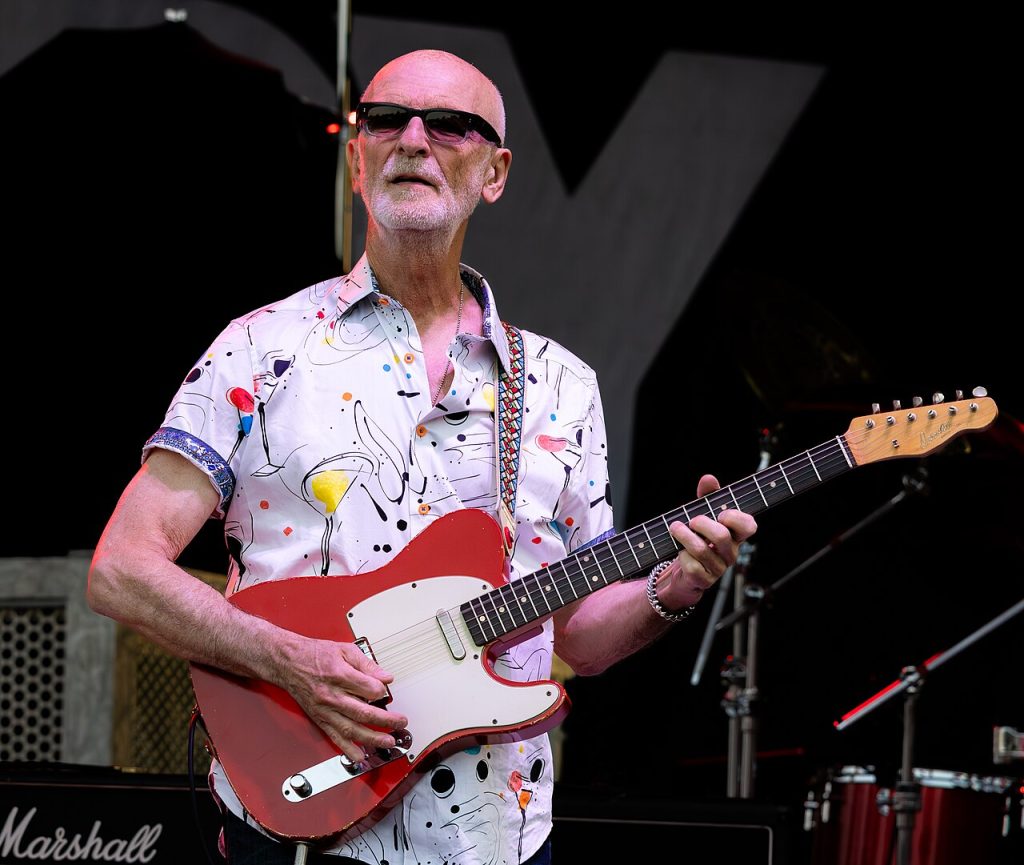
Photo by Chris Woodrich
It’s been a long while since I have talked about Kim Mitchell, but he’s still around and still playing music. He first gained fame as the lead singer and guitarist of the terminally underappreciated rock band Max Webster. He later built an impressive solo career that produced numerous radio hits and multiple Juno Awards. His work helped define a distinctive era of Canadian rock in the 1970s and 1980s. The recent passing of former Max Webster keyboardist Terry Watkinson on February 28, 2026, at age 85 has brought renewed attention to the band’s legacy and Mitchell’s contributions.
Born Joseph Kim Mitchell on July 10, 1952, in Sarnia, Ontario, he attended St. Clair Secondary School. There he developed an early passion for guitar and began performing with local bands during the 1970s. One of those groups went through several name changes before settling on Zooom. The band eventually relocated to Toronto in search of bigger opportunities. After Zooom dissolved, Mitchell took time to travel to the Greek islands. Upon his return to Canada, he reconnected with childhood friend and lyricist Pye Dubois, another Sarnia native. Together they formed Max Webster in Toronto around 1972.
The band started as a trio with Mitchell on guitar and vocals, bassist Mike Tilka, and drummer Phil Trudell. They played under temporary names before adopting Max Webster, a title suggested by Tilka. By early 1973 the lineup expanded. Keyboardist Jim Bruton joined briefly, followed by Terry Watkinson in 1974. Drummer Paul Kersey came in during 1973 but was replaced by Gary McCracken in 1976. Bassist Dave Myles later filled in after Tilka departed. This core group created a sound that blended hard rock with progressive elements and surreal, poetic lyrics supplied primarily by Dubois.
Max Webster released their self-titled debut album in 1976, which reached number 32 on the Canadian charts and earned gold certification. Follow-up releases included High Class in Borrowed Shoes in 1977 and Mutiny Up My Sleeve in 1978. Their big break came with A Million Vacations in 1979. That platinum-selling record featured hits such as “Paradise Skies,” which climbed to number 43 on the UK singles chart, and “Let Go the Line,” a track written and sung by Watkinson that peaked at number 41 in Canada. Universal Juveniles arrived in 1980 and included the live collaboration “Battle Scar” with Rush. A compilation titled “Diamonds Diamonds” appeared in 1981.
The band toured relentlessly, often playing 200 to 250 dates per year. They opened for major acts including Rush, with whom they shared the stage more than 200 times and earned the nickname Rush’s little brother band. Other support slots came with Genesis, Cheap Trick, Styx, and Peter Gabriel. They performed at high-profile venues such as Toronto’s Maple Leaf Gardens and London’s Marquee Club. Despite major Canadian success and all albums achieving gold or platinum status, international breakthroughs remained limited. Creative and industry pressures mounted. Exhaustion from constant touring combined with insufficient label support from Capitol Records led to the band’s dissolution after a final show supporting Rush in Memphis on April 16, 1981.
Mitchell briefly worked as a session guitarist and producer before launching his solo career. In 1982 he released a self-titled EP that showcased a shift toward a more accessible pop-rock style while retaining his sharp guitar playing and Dubois’s lyrical input. The EP earned him his first Juno Award for Most Promising Male Vocalist. His full-length debut Akimbo Alogo followed in 1984 and became a commercial highlight. The single “Go for Soda” reached number one in Canada, number 86 on the Billboard Hot 100 in the United States, and even charted in the UK. Other tracks such as “All We Are” and “Lager and Ale” solidified his radio presence.

Mitchell hit a career peak with Shakin’ Like a Human Being in 1986. Certified triple platinum in Canada, the album won the Juno for Album of the Year in 1987. Standout singles included “Patio Lanterns,” which topped the Canadian chart, along with “Alana Loves Me” and “Easy to Tame.” Rockland arrived in 1989 and delivered further successes with “Rock ‘n’ Roll Duty” and “Rockland Wonderland.” It peaked at number four on the Canadian albums chart and reached double platinum status. Mitchell collected another Juno for Male Vocalist of the Year in 1990.
Subsequent albums maintained his popularity at home. Aural Fixations came in 1992 and went gold. Itch followed in 1994. Kimosabe appeared in 1999. Ain’t Life Amazing was released in 2007, and The Big Fantasize arrived in 2020. Throughout these years Mitchell opened for international stars including Aerosmith, Van Halen, Def Leppard, and Sammy Hagar. He also contributed a guitar solo to Barenaked Ladies’ Wind It Up in 2006. From 2004 until 2015 he hosted the afternoon drive-time show on Toronto’s Q107 radio station, bringing his rock knowledge to a new audience.
Mitchell has received additional honors. In 2004 SOCAN presented him with its National Achievement Award. He was inducted into the Canadian Songwriters Hall of Fame in 2021. Max Webster itself received induction into Canada’s Walk of Fame in 2023, with surviving members including Mitchell attending the ceremony. Occasional reunions occurred in 1990, 1995 through 1996, and 2007, keeping the band’s catalog alive for fans.
The recent death of Terry Watkinson serves as a poignant reminder of Max Webster’s enduring impact. Watkinson, who served as the band’s longest-tenured member after Mitchell and contributed memorable songs such as “Let Go the Line,” passed away peacefully in his sleep. His keyboard work and vocal harmonies were integral to the group’s classic sound. Mitchell’s path from Sarnia’s local stages through Max Webster’s arena tours to decades of solo hits illustrates a remarkable career built on talent, perseverance, and a deep connection to Canadian rock roots. At age 73 he continues to perform and inspire new generations, ensuring that both his band legacy and solo achievements remain vibrant parts of music history.