Igniting a Legend: Jimi Hendrix Sets His Guitar on Fire at Monterey
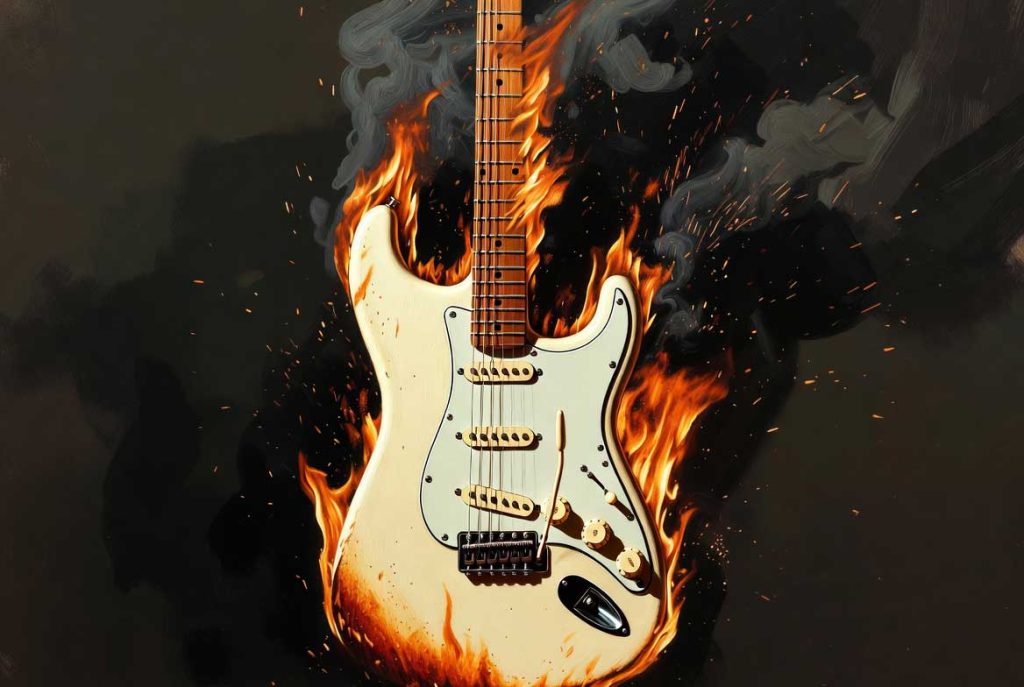
The crowd at the Monterey International Pop Festival buzzed with anticipation on the evening of June 18, 1967 and with good reason. Thousands of them had gathered at the fairgrounds of the coastal California town for a weekend that promised to showcase the brightest stars of the emerging rock scene. Even under those circumstances, no one could have predicted the moment that would etch itself into music history. Jimi Hendrix, the charismatic guitarist who had recently electrified audiences across Britain had stepped onto the stage with his band the Jimi Hendrix Experience. What followed was not just a performance but a visceral act of artistic rebellion that climaxed with Hendrix setting his guitar ablaze.
Hendrix arrived at Monterey as something of an unknown quantity in his native United States. Born in Seattle in 1942, he had honed his skills in rhythm and blues bands before relocating to London in 1966. While there, manager Chas Chandler paired him with bassist Noel Redding and drummer Mitch Mitchell. Their debut single “Hey Joe” had climbed the British charts and their album Are You Experienced? was generating excitement across the Atlantic.
Festival organizers including John Phillips of the Mamas and the Papas added the group at the last minute after an enthusiastic recommendation from Paul McCartney. The lineup already featured heavyweights such as Otis Redding, the Who and Janis Joplin. Jimi Hendrix knew he needed to make an unforgettable impression to win over American fans.
The festival was a landmark event held over three days in June. It drew more than fifty thousand attendees and captured the spirit of the Summer of Love. Unlike later commercial gatherings, Monterey apart by emphasizing artistic freedom and community. Performers received no payment beyond travel expenses and the atmosphere fostered genuine musical exchange. Cameras rolled as director D. A. Pennebaker who captured the historic footage that later became the acclaimed documentary Monterey Pop. This setting provided the perfect backdrop for Hendrix to unleash his creative fury.
As the sun dipped low over the fairgrounds the Jimi Hendrix Experience launched into their set. They opened with a blistering rendition of “Killing Floor,” a Howlin Wolf classic that showcased Hendrix’s uncanny ability to bend notes and command the stage. “Foxy Lady” followed with its sultry riffs and Redding steady bass line anchoring Mitchell’s explosive drumming. The band moved seamlessly through songs from their repertoire including a soulful version of “Hey Joe.” Each track highlighted Hendrix’s innovative techniques such as playing the guitar with his teeth or behind his back. These flourishes were not mere gimmicks but extensions of his deep musical intuition forged through years of relentless practice and touring.
The energy built steadily until the group reached their finale. Hendrix introduced the song “Wild Thing” by the Troggs as a playful closer. What began as a straightforward cover quickly transformed into something transcendent. He coaxed feedback from his white Fender Stratocaster, manipulating the instrument as if it were a living extension of himself. He dropped to his knees, set the guitar down and reached for a bottle of lighter fluid. The audience watched in puzzled silence as he doused the guitar with the flammable liquid. Striking a match he touched the flame to the body of the instrument. Orange fire erupted across the strings and wood sending sparks into the night air.
He rose to his feet, swung the instrument wildly and smashed it against the stage amplifiers. Pieces of the Stratocaster flew into the crowd as he hurled the remnants forward. The act combined elements of performance art, ritual sacrifice and pure rock theater. Smoke lingered in the air while the final notes faded into stunned applause. It was probably safe to say that the audience had never seen anything quite like it.
This fiery spectacle drew immediate comparisons to the Who who had earlier demolished their own instruments in a display of controlled chaos. Pete Townshend later expressed mild annoyance at being upstaged. But Hendrix’s gesture carried with it a deeper symbolism. It represented a rejection of convention and a brazen willingness to destroy something valuable in pursuit of raw expression. The guitar had become both a tool and an offering in a moment that blended blues roots with psychedelic experimentation.

Reactions rippled rapidly through the festival community. Brian Jones of the Rolling Stones watched from the wings visibly impressed by the audacity. Fellow musicians recognized the performance as a true turning point. Within days word spread through the music industry and Hendrix’s star began its rapid ascent in America. The Monterey set opened doors to major tours and collaborations and by the end of 1967 he had headlined venues across the country and cemented his reputation as a visionary artist.
The incident also highlighted broader cultural shifts during and uncertain and pivotal time. The late 1960s witnessed young people questioning authority and embracing new forms of self expression. Hendrix’s guitar burning embodied that ethos, turning a simple, common musical tool into a canvas for rebellion. That act influenced countless performers who followed by incorporating elements of the spectacle into their own performances. From pyrotechnics in arena rock to the conceptual destruction seen in later punk and metal acts, the Monterey moment set a precedent that lives on today.
Pennebaker footage preserved the event for posterity. Viewers of the documentary can still witness the flames dancing across the strings and the crowd’s collective gasp. The Stratocaster, itself a model customized for left handed play, became legendary. Though destroyed in the act, replicas and tributes have appeared in museums and exhibitions worldwide. Hendrix continued to push boundaries until his untimely death in 1970 but there is little doubt that the Monterey performance remains his most iconic visual statement.
In retrospect, the guitar burning was more than just a dramatic stunt. It fused technical mastery with theatrical flair and resulted in an experience that transcended the music itself. Hendrix drew from diverse influences including blues legends and avant garde ideas to craft something entirely new and exciting. The festival provided the ideal stage and the timing aligned perfectly with the counterculture movement of the day. What unfolded that night in Monterey was not destruction for its own sake but was also creation through chaos.
Today the event still stands as a defining cornerstone of rock history. It reminds us that innovation often requires risk and that true artistry can emerge from unexpected gestures. Jimi Hendrix left the stage amid cheers and smoke having transformed a routine set into an enduring legend.